Speaking & Hosting the Testing Olympiad @SeleniumDay Bangalore- My Experience Report

My company @Sahi Pro was a proud sponsor and Exhibitor at the Selenium Day Event organised by 1.21GWs on 30-31st Jan 2020 at Bengaluru, where I was involved in a number of ways-

>I presented a talk on “Layered Approach to Test Automation”

Presenting My Talk at Selenium Day

>Sahi Pro team had put up a demo booth with engaging discussions, quiz and goodies for the attending delegates

>I also got to organize and host a fun and engaging Testing Olympiad Finale at the event! The event team had organised on online quiz followed by a Semi-Final round in the day of the event. The finalists were the 4 teams selected base don their performance and @Sahi Pro was tasked with creating a suitable finale to select the Best Testing Team.

I got to work and wracked my brain on how best to create the quiz such that it is suited for the varied levels and profiles of participating test personnel, does justice to their knowledge and is a fair ground for all, and is fun and engaging not only for the delegates but also for the audience. I came up with 5 rounds conducted in a stage show style format , each very different and relevant to diff areas like 1) Testing fundamentals – On the Clock 2) Attention-to-Detail- Buzzer round that checks Tester’s key skills 3)DevOps & Test automation round 4) Audio – Visual Round and 5) Rapid Fire round for the top 3 teams.

Our Sahi Pro team helped me conduct the quiz beautifully by keeping time, managing the score-boards and helping with the audience questions. This sure was the highlight of the day for not only the finalist participants but also the audience as they got a chance to win exciting Sahi Pro goodies!

Me hosting the Testing Olympiad Finale

The winners were announced after a thrilling contest comprising 5 rounds of Testing fundamentals, DevOps & Automation round, Audi-visual round, Attention to detail and the final Rapid Fire Round! The details of the winners have been announced here too – https://www.linkedin.com/feed/update/urn:li:activity:6629658639214972928/

We felicitated the winners along with 1.21GWs organising team and ended the day with some cool pictures as memories of the grand day!

I learnt a lot while preparing the quiz, talking to my peers and friends on improving it, collating feedback and improving it over a course of 3 weeks. I also enjoyed conducting the event as a host – keeping the energy alive, engaging audiences, cheering & motivating participants and keeping it fair at all times! I am excited to say we received such great feedback and kudos from the organisers for putting up a great show! #Grateful

Looking forward to many more great events in 2020! 🙂

Upcoming Talks and Events 2020

The year 2020 has started on a good note. I am excited to have been invited to speak at amazing events. Here is a list of my upcoming talks and events–

The details of each of these events and my talks can be found at their respective websites at->

Selenium Day : https://seleniumday.com/

DevopsCon Singapore: https://devopscon.io/singapore/program-singapore/

TestBash Detroit: https://www.ministryoftesting.com/events/testbash-detroit-2020

Looking forward to each of these!

*********UPDATE********

Things changes drastically as 2020 progressed.

Events have been postponsed / cancelled / moved online due to lockdowns due to COVID-19 Pandemic

You will find new details of the events , schedule and my talks in later posts.

**************************

The Partnership of Testing and Checking

Human Testing is a craft that is more than executing a bunch of tests, performing clicks and actions. A tester has a unique understanding of the system and ways to critique it. Over time, the tester develops a deeper comprehension of the application and its intricacies, integrations, weak points, and history. This makes them the best judge to find out the failure points of the system and comment on its health.

The Product Risk Knowledge Gap is the difference between what we know about the product and what we need to know. The purpose of testing is to close or at least reduce this gap.

While automated checks can help in determining problems in what we know (and have scripted as checks), it may not help as much in the risk areas of what we do not know about the product. That requires exploration, creativity, intuition and domain knowledge. This is the human aspect of testing.

The creative and human aspects of testing lie with the tester, which I have experienced as well as written about a few years back as a hands-on tester myself here – https://testwithnishi.com/2014/12/31/automation-test-suites-are-not-god/

Your Name: Review:

Automated Checks-

Automated scripts have some built-in steps in the form of test data that we pre-define and verifications that we add. These steps are helpful for areas of the application that we need to check, double-check or re-check a number of times, and because these types of checks can be made explicit, they can be automated. Since the same steps will be performed the same way over and over again, it is better called “checking” rather than “testing.”

Read More »

Top 3 New Year Resolutions for Testers!

Here we are gearing up for another new year! As time flies by, we may start to feel stuck in one place, unable to move forward in our careers. Testers can get bogged down by too much to learn, too many directions to take, and so many tools and technologies.

But that’s no reason to stagnate. By making some goals now, you can aim to start improving yourself and your career development right away on January 1st.

Here are three goals testers should have for the coming year. Make it your New Year’s resolution to achieve them, and go for it with an action plan in hand! Read the full article at –> https://blog.gurock.com/new-year-resolutions-testers/

Improve your Mindset

The first resolution should be to create and maintain a healthy mindset. Mental peace and team harmony should be the goal.

Continue Learning

There must be a routine, a drive to better oneself and a constant search for improvement. All testers must resolve to take up some kind of continuing education so they can always be adding to their skill sets. Learning cannot be a one-time activity.

Get Better at Networking

The next resolution a tester must make is to participate in the community in some way.
The knowledge you have is better shared with others, and the pace of learning in a community will be much faster than alone.

Read More —>

Mental Health for people in tech

The technical industry is characterized by high stress, long work hours as well as workplace pressure. This demanding environment blurs the line between your professional and personal life.

Your mental health suffers a lot in the constant social pressure to network and make a name for yourself. Here, are certain ideas to implement at your workplace to take care of your mental health.

Speak your mind

Speaking your mind can help you maintain your mental health. Don’t consider sharing your feelings as a sign of weakness; it’s a part of taking charge of your wellbeing.

Though it’s hard to talk about feelings at work, but if you have colleagues you can talk to, it can really help. Find your tribe at work who can be your peers with whom you can share your day to day problems, issues and seek advice, or open up with family and friends outside work.

Identify triggers

Everyone has different triggers for anxiety in the workplace. It could be doing a presentation or writing reports or going to a company function. You must track situations that make you uncomfortable in order to prepare.

Read More »

Defining Exit Criteria for different phases of your Agile project

Exit criteria are a list of items to check off that define the end of any activity. Exit criteria can be defined for any activity you want to undertake: You can have exit criteria for cooking veggies to the desired doneness, or for a city tour to be sure you see all the sights, or for a meeting to assign action items for everyone! Exit criteria are helpful to tell you (and others involved) when to stop the activity. Specifically, for an agile project, having clear and concise exit criteria makes it easier to understand the scope and avoid going overboard while keeping a tab on your quality. 

In my article published at Gurock https://blog.gurock.com/agile-exit-criteria/ , I have discussed some ways to structure your exit criteria at the sprint, user story, and task levels in an agile project.

The first rule for exit criteria is to have them defined up front, before beginning the activity.

For an agile project, let’s say we want to have exit criteria in place for the end of the sprint. We will need to work on defining them at the beginning of the sprint, or at the release-planning stage. Once the activity begins, the goal is to achieve all exit criteria by the end. We cannot have people defining or changing the planned exit criteria during execution of the activity, since that will not be upholding the quality standards set in the beginning.

The second rule is to have standard exit criteria for all similar activities. So, exit criteria defined for the sprint level apply to all sprints in that release, and exit criteria defined for the user story level apply to all user stories in all sprints. This upholds the same standard of quality and expectation of work required for each of these work units.

In the article, I have discussed sample Exit Criteria for Sprint, User Story or Task level and also shown how to create your own exit criteria based on your project’s and team’s context.

The important things to focus on are having the exit criteria defined up front and ensuring follow-through by sticking to the criteria throughout your release cycle. Being consistent with checking off everything on your exit criteria list ensures a smooth flow of high-quality work.

Check out the complete article here – >

Guest Talk at Qapitol QA

I was invited by Ajay Balamurugadas to present a guest talk at his organisation Qapitol QA for their enthusiastic test team. I spoke about Layers of Test Automation to design a robust test automation framework. The topic was well received and the testers in audience showed keen interest and had some good questions! It was a good experience visiting and meeting the team and presenting a short demo of Sahi Pro too!

The testers at Qapitol QA are surely an inquisitive lot with a dynamic attitude and quest for learning. They showed a lot of interest in Sahi Pro as a tool, and also about test automation in general. I like to encourage such talent and help them in any possible way. I wish to continue the relationship and see them again in future events.

Metrics your Agile team should & should not be tracking!

Agile teams are constantly running toward goals, requiring constant planning, monitoring, and re-planning. Metrics can help support these efforts by providing useful information about the health and progress of the project.

There are a few common metrics we use in agile teams: sprint burndown charts, release burnup charts, team velocity. They’re common because they communicate practical information, but they’re not the only metrics we can employ.

In my recent articles for TestRail blog, I described 3 Uncommon metrics you can easily create that will be very useful for your agile team. I also wrote about 3 Metrics that are not useful and you must stop using now!

Here are the posts–>

Three Uncommon Metrics Your Agile Team Should Be Tracking

Here I described 3 most useful metrics –

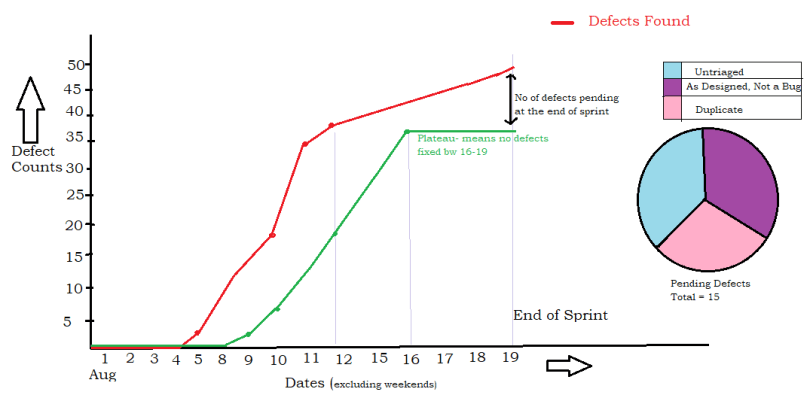
Defect Health

Defect Health Chart

Test Progress

Metric for weekly test progress

Build Failures

Sprint-wise metric for No of Build Failures

Click here to read the complete article —>

Three Metrics Your Agile Team Should Stop Using

Metrics are supposed to help and support an agile team by providing useful information about the health and progress of their project. But not all metrics are always beneficial. Going overboard with them can sometimes cause more harm than good.

In this post I have described three metrics that can impede your agile team instead of motivating you.

  • Defect Counts
  • Hours
  • Lines of Code or Defect Fixes per Developer

Click here to read the complete article–>

Please share your experiences with metrics and how they helped or impeded your progress!

Cheers

Nishi

Overcoming Barriers to Effective Communications in Agile Teams

Communication is the foundation of success for an agile team. Agile teams need to set up effective communication channels and have a culture of constant communication for complete transparency.

However, there are often several challenges that act as barriers to productive communication and may lead to people problems as well as delayed or failed projects. In my article for TestRail https://blog.gurock.com/agile-barrier-communication/ , I have discussed some of the most common barriers to effective communication for agile teams, as well as how you can overcome them.

  • Physical Barriers
  • Cultural and Language Barriers
  • Emotional Barriers
  • Perceptual Barriers

Read the complete article here ->

Agile teams require constant communication, so it immensely benefits the team to recognize their barriers to effective communication and take some measures to overcome these barriers. Every step taken in this regard leads the team farther down their path to true agility.

Speaking at the DevOps & Agile Testing Summit – 8Nov’19, Bangalore

I was invited to speak at the DevOps and Agile testing Summit organised and conducted by 1.21GWs on 8th Nov 2019 at Bangalore. It was a great event which brought together many keen minds as delegates and many inspiring speakers. https://1point21gws.com/devops/bangalore/

My talk was on “The Building Blocks of a Robust Test Automation Strategy”. As we know testing teams are faced with a number of questions, decisions and challenges throughout their test automation journey. But there is no single solution for their varied problems! In this talk I outlined a number of strategies that agile teams can follow– be it their selection of what to automate and how much, what approaches to follow, whom to involve, and when to schedule these tasks so that the releases are of best quality.

I am grateful that my talk was so well received and led to great discussions later with many participants. I enjoyed the day and am always glad to be invited by the 1.21GWs team.

A peek into the event – pictures from my session

@Sahi Pro was also a knowledge partner at the event and delegates also got a peek into Sahi Pro via video and brochure handouts.

Looking forward to many more successful events! 🙂