It is my pleasure and honor to share that my article on
“Let the Agile Manifesto guide your Software Testing”
published on Techwell Community forum http://www.stickyminds.com in 2017 has now been featured in the list of “Hottest Articles of 2017” , featuring in the Top 10 Most Read articles last year!
“Agile Testing Reflections 2017” – I have written this as a look back on 2017 – what we learnt this year and taking these learnings forward to the new year.
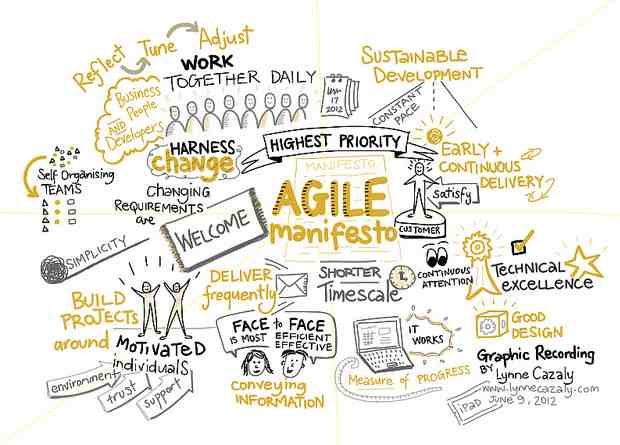
I was invited to present a guest talk at the meetup organised by ET Marlabs team for EUROSTAR 2017 on 9th Sep 2017- being the first of its kind in India and I gladly obliged! Presented a talk on Agile Manifesto and its learning for keen testers and answering our dilemmas in agile testing. The talk was very well received and brought out some great discussions with the participants. I was accompanied by another guest speaker Mr. Vinay Krishna who spoke about Behavior Driven Development BDD framework using Cucumber which was a very informative session too.
The team at ET Marlabs had also organised some great activities, testing relay game and quiz for the participants which brought out their testing minds and enthusiasm , which was well rewarded too! I would like to thank them for their kind invitation and would encourage them to organise and participate in more such community events!
My article on the relationship of Agile Manifesto to the efforts and dilemmas of software testing has been published at stickyminds.com
Here are excerpts from the article – Please visit https://www.stickyminds.com/article/let-agile-manifesto-guide-your-software-testing and share your views too!
The Agile Manifesto is the basis of the agile process framework for software development. It sums up the thought process of the agile mind-set over the traditional waterfall methodology, and it’s the first thing we learn about when we set out to embrace an agile transition.
The Agile Manifesto applies to all things agile: Different frameworks like Scrum, DAD (Disciplined Agile Delivery), SAFe (Scaled Agile Framework), and Crystal all stem from the same principles.
Although its values are commonly associated with agile development, they apply to all people and teams following the agile mind-set, including testers. Let’s examine the four main values of the Agile Manifesto and find out how they can bring agility to teams’ test efforts.
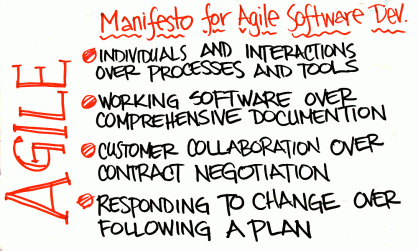
Individuals and Interactions over Processes and Tools
Agile as a development process values the team members and their interactions more than elaborate processes and tools.
This value also applies to testers. Agile testing bases itself in testers’ continuous interaction and communication with the rest of the team throughout the software lifecycle, instead of a one-way flow of information from the developers or business analysts on specific milestones on the project. Agile testers are involved in the requirements, design, and development of the project and have constant interaction with the entire team. They are co-owners of the user stories, and their input helps build quality into the product instead of checking for quality in the end. Tools are used on a necessary basis to help support the cause and the processes.
For example, like most test teams, a team I worked on had a test management system in place, and testers added their test cases to the central repository for each user story. But it was left up to the team when in the sprint they wanted testers to do that. While some teams added and wrote their test scenarios directly on the portal, other teams found it easier to write and consolidate test cases in a shared sheet, get them reviewed, and then add them all to the repository portal all at one go.
While we did have a process and a tool in place to have all test cases in a common repository for each sprint, we relied on the team to decide what the best way for them was to do that. All processes and tools are only used to help make life easier for the agile team, rather than to complicate or over formalize the process.
Working Software over Comprehensive Documentation
With this value, the Agile Manifesto states the importance of having functioning software over exhaustively thorough documents for the project.
Similarly, agile testers embrace the importance of spending more time actually testing the system and finding new ways to exercise it, rather than documenting test cases in a detailed fashion.
Different test teams will use different techniques to achieve a balance between testing and documentation, such as using one-liner scenarios, exploratory testing sessions, risk-based testing, or error checklists instead of test cases to cover testing, while creating and working with “just enough” documentation in the project, be it through requirements, designs, or testing-related documents.
I worked on an agile project for a product where we followed Scrum and worked with user stories. Our approach was to create test scenarios (one-liners with just enough information for execution) based on the specified requirements in the user story. These scenarios were easily understood by all testers, and even by the developers to whom they were sent for review.
Execution of test scenarios was typically done by the same person who wrote them, because we had owners for each user story. Senior testers were free to buddy test or review the user story in order to provide their input for improvements before finalizing the tests and adding them into the common repository.
Customer Collaboration over Contract Negotiation
This is the core value that provides the business outlook for agile. Customer satisfaction supersedes all else. Agile values the customer’s needs and constant communication with them for complete transparency, rather than hiding behind contract clauses, to deliver what is best for them.
Agile testing takes the same value to heart, looking out for the customer’s needs and wishes at all points of delivery. What is delivered in a single user story or in a single sprint to an internal release passes under the scrutiny of a tester acting as the advocate for the customer.
Because there is no detailed document for each requirement, agile testers are bound to question everything based on their perception of what needs to be. They have no contract or document to hide behind if the user is not satisfied at the end of the delivery, so they constantly think with their “user glasses” on.
As an agile tester, when I saw a feature working fine, I would question whether it was placed where a user would find it. Even when the user story had no performance-related criteria, I would debate over whether the page load time of six seconds would be acceptable. After I saw that an application was functionally fine, I still explored and found that the open background task threads were not getting closed, leading to the user’s machine getting hung up after few hours of operation. None of these duties were a part of any specification, but they were all valuable to the user and needed correction.
Responding to Change over Following a Plan
Agile welcomes change, even late in development. The whole purpose of agile is to be flexible and able to incorporate change. So, unlike the traditional software development approaches that are resistant to change, agile has to respond to change and teams should expect to replan their plans.
In turn, such is the case for agile testing. Agile testing faces the burden of continuous regression overload, and topped with frequent changes to requirements, rework may double itself, leading to testing and retesting the same functionalities over and over again.
But agile testing teams are built to accommodate that, and they should have the ability to plan in advance for such situations. They can follow approaches like implementing thorough white-box testing, continuously automating tested features, having acceptance test suites in place, and relying on more API-level tests rather than UI tests, especially in the initial stages of development when the user interface may change a lot.
These techniques lighten the testing team’s burden so that they can save their creative energies to find better user scenarios, defects, and new ways to exercise the system under test.
Let the Agile Manifesto Guide Your Testing
When agile testers have dilemmas and practical problems, they can look to the Agile Manifesto for answers. Keep it in mind when designing and implementing test efforts; the Agile Manifesto’s values will guide you to the best choice for your team and your customers.
My latest article for stickyminds.com focused on the essential differences between Agile and traditional approach of testing >> published here
****
The agile world is abuzz nowadays with talk about agile testing and the key role of testers in an agile project. Some even say testers are the key piece of an agile team, arguing that they define the success or failure of the team’s attempts to be agile.
But what makes agile testing different from traditional testing? It’s the distinctions between the agile and traditional software development approaches, but also the adaptability of testers in these very different environments. Agile demands more from its testers, and, in turn, it values them more, too.
Let’s look at five main things that make an agile tester’s life different from that of a traditional tester.
Continuous Involvement
In traditional projects, the test team works mostly in a silo, and there is little or no interaction needed with developers or other teams on a daily basis. But in agile, the test team is integrated with the Scrum team instead of being a separate unit. They need to be continuously involved in all aspects of the project, starting with the requirements and design of each feature. This makes the testers’ days busier with discussions, meetings, and interactions where they need to put forward their opinions.
Agile necessitates that everybody report to the Scrum team first and their separate testing or development team later. In my experience as a part of a Scrum team, we would discuss our vacations or skill training needs first within the Scrum team, then inform our test manager afterward.
Essential Tools
Agile needs tool support more than traditional projects do because of the pace of development and continuous iterations. Each iteration brings along some regression work from the previous iterations that needs to be automated quickly.
The same is true for test data generation, white-box testing tools, and static analysis tools, which become a necessity in an agile system. Given the time and quality constraints, performing white-box tests using control flow or data flow analysis, static analysis of code, or reviews for code and documents is no longer optional. Instead, it’s a mandate to prevent defects and ingrain quality into each work product.
While in traditional projects, tools may be a luxury we might not be able to afford, in an agile project they become a necessity. Testers need these tools’ abilities in order to achieve their quality targets.
When my team began our agile transformation, we had one automation engineer who would work on automation scripts for the entire project. But when pacing through the sprints, we quickly realized that one automation engineer was not able to keep pace with automating all features in all sprints. So, everybody started pitching in by scripting the features they tested, and eventually it was mandated. The automation expert was only used for framework-level implementation, and later he was absorbed as a functional tester.
Due to frequent changes in the application within the sprint, we would follow an (n–1) approach to automation of our product, automating the features of the nth sprint in the next sprint, then subsequently using them for regression. But due to overload of regression building up as we progressed, it was crucial that each tester be able to perform and use the tools effectively, building up the test suites every sprint.
Multidimensional Skills
A traditional project has set expectations from the testers and testing activities. Each phase of testing gives set outputs, such as test design and specifications in the design phase, functional issues and defect reports in the execution phase, regression tests and retest results in reruns, and acceptance test reports in the end phase. This pattern does not leave much room for anything else because the project is already hard-pressed at the deadline.
But an agile tester’s viewpoint covers not only the functional aspects of what he is testing, but also many broader aspects of the application. He need not be a performance testing expert to suggest during the design discussions that the design might not be able to support too many users. He may not be a usability expert, but he can suggest better ways to design the web form of their user story. He may not be a technical writer, but he may be required to review the installation guide steps. An agile tester has to have a broader perspective of quality in his project’s context and possess skills in all those areas.
Effective Communication
Agile requires effective communication among the team members at all times, and testers play a key role in establishing and maintaining that. For example, as a part of a Scrum team, a tester will be required to wear many hats: that of a requirement critic for the product owner, of a design reviewer for the developers and architects, of a functionality expert as a tester, and of a release adviser to the manager. Testers have to give their opinions and ideas at all stages of the project, which may be not required (or even much welcomed) in a traditional project.
Testers act as the binding force of the team when they work in pairs with developers, sharing their test cases and ideas, as well as when they work as a quality reporter for the manager, with daily statistics and defect metrics for each sprint. The art of verbal and written communication is essential in an agile project.
Quick Feedback from Testing
The most important difference for agile testers is the quick feedback being given from the testing perspective at every point. The agile timeframes are shorter than on a traditional project, and testing needs to provide feedback about project quality on a regular basis. Daily stand-up meetings, design discussion or review meetings, the user story verification status, and sprint retrospectives all require constant feedback from testers.
There is some additional pressure because the direction of the project gets defined by this feedback, and there is no final “quality gateway” at the end if the project does not meet the deadlines or quality goals. This keeps the testers on their feet at all times, unlike in traditional projects where testers are required only at the end of the project for a sign-off.
Working in an agile environment can be challenging for testers coming from traditional projects, but by being open, flexible, and adaptive, they will find that an agile team is a wonderful place to be a tester.
I am glad to share that my latest article found its way to agileconnection.com !
Here are some excerpts from the article –
Many organizations have issues during the transition to an agile workflow. Some teams never quite recover from that transformation stage; they say they tried agile but it didn’t work for them, or they are still struggling to get it going. If we look for the real reason behind all these troubles, I bet the majority fo the time, it would be communication.
Agile is designed for smaller that want to get more done with fewer formal processes. Iteratively building and demonstrating the desired products for more immediate feedback is the goal.
Think about the common practices of an agile team: daily stand-up meetings, retrospectives after every sprint, pair programming and buddy reviews, collaborating with customers, and more face-to-face time instead of mountains of documentation.
What is the agenda behind all these operations? Frequent and open communication.
Agile teams are designed so that everybody is aware of everyone’s tasks, progress, strengths, and output each day. The difficulty is communicating all this information.
Let’s say a team was working on a sprint with some defined user stories. The team started working on their assigned stories, using what little was specified in the requirements and assuming the rest. Nothing much was brought up in the daily stand-up meetings, which were short and missed often. The developers worked on their stuff, and in the last few days of the sprint passed their code on to the testers, who began their test design parallel to the test execution. Most of the testing was done in an exploratory fashion, owing to the lack of information and time.
Of course, problems arose. Testers blamed faulty designs and the lack of information provided to them. In turn, the developers blamed the specifications. The manager—who was missing for most of the sprint—now appears and questions the team about the quality issues. Most of the user stories become spill-over items to work on during the next sprint due to the design changes needed.
Unfortunately, this is probably not an unfamiliar situation for many of you. An agile team can’t succeed if communication is lacking.
The team in the example earlier could have done much better if they had nurtured their communication skills. The developers should have discussed the specifications and pointed out missing or ambiguous aspects to the manager, who then would have talked to the clients to get clarifications. The test team should have been involved in all these communications, building their tests in parallel and getting them reviewed. Developers and testers should have coordinated their user stories to buddy test the features and get maximum issues resolved in advance. And everyone should have been participating in stand-up meetings to communicate progress and risks. If this had happened, by the end of the sprint the user stories would have been resolved, and the team could have delivered a better-quality product.
Naturally, it’s easier to look at a failed project afterward and point out what should have been done differently. How can you set your team up for success from the beginning? Before even seriously considering the logistics of agile adoption, you should start looking at all aspects of communication in your teams.
The assigned ScrumMasters must have the ability to communicate and manage the team well, as well as encourage teammates to speak their minds. The agile team may need some verbal or written skills training if they are not used to informal communications via chats, email, or short documents.
All communication within the agile team must be addressed to the complete team, including sharing any documents, release plans or schedules, review requests and feedback, risks or concerns, and even leave updates. This builds a complete sense of oneness within the team and maintains complete transparency at all times.
The managers and leads must ensure open communication and healthy feedback during all meetings and also encourage team members individually to share their ideas and opinions. Likewise, the team must be receptive to constructive criticism and ready to learn from their mistakes.
Only in such an environment will the real agile spirit thrive and teams will be able to find success in their endeavors.
Pages
Read the complete article and do share your thoughts!
When I heard about the ATA-Global Gathering event happening in Bangalore , I was super-excited to be a part of it! So, I sent my proposal to Nitesh from UNICOM and Tushar from ATA who are both great at organizing such great events. They liked it and voila! I was in the Speakers list on the site 🙂 check it out –
My session went great and was very well received by the audience. We talked about Gamification of Agile teams and had some awesome volunteers playing fun games with us. The audience was totally engaged in the session and we got great feedback! 🙂 🙂 Here is a peek into the highlights of the day –
Testers who analyze quality in every aspect of the team’s deliverable also have a responsibility to mitigate risks and practical issues that are bound to come up, and help the team succeed in their product as well as at being agile. Here are five such issues that testers can help the team alleviate or avoid.
SAMPLE SCENARIO:
Let’s say an agile team has a user story to develop a webpage in a sprint. The product manager mentions only the mandatory fields of the webpage in the story’s description while scoping it in the sprint. The developer works on the story for a couple of days and adds the listed fields on the page, but because he going on leave for a few days, he only provides the basic form fields without any input validations or error messages on the page.
Once back from his vacation, he checks in the code and shares it for testing a day before the sprint ends. The tester tests it for a day and raises some minor severity issues. In the final sprint demo, the product manager points out that a number of fields are missing on the webpage. Because testing is not complete yet, the story is tagged as a spill-over item to the next sprint. Few UI changes are added in the next sprint’s scope, along with the pending validations and error messages.
What do you think went wrong in this story?
Agile is all about controlling and minimizing the typical risks of conventional software development techniques. When working with agile, we have the flexibility to control our direction and steer our path based on unforeseen and unplanned changes and events.
But it is the same flexibility and dynamic nature that makes agile prone to many risks during the project.
These risks are the practical issues that any agile team is bound to face eventually and that, if not handled quickly, may lead to failure of the sprint or the agile process as a whole. Testers who analyze quality in every aspect of the team’s deliverables also have a responsibility to mitigate these risks and help the team succeed in their product as well as at being agile.
Here are five such issues that testers can help the team alleviate or avoid.
The power of Five!
Risk 1: Ambiguous User Stories
Agile assumes that each user story is a unit of work to be achieved in a sprint. The user story needs to be granular enough and have all relevant details and context when scoped. But because agile also recognizes changing requirements as likely, this gets used as an excuse to not list the requirements for each user story or give details early on. This leads to ambiguous requirements, often resulting in low-quality outcomes and rework on the feature.
The actual aim of agile is to work on a feature based on the best knowledge of its requirements at the given time. The sprint format in the Scrum process leaves scope to work on a feature again if enhancement is needed. But that is based on collecting all available information for one story and only then scoping it in a sprint. If that is not ready yet, the story should not be scoped in the current sprint.
Testers in an agile team have the responsibility of reviewing user stories when they are being planned for the sprint and requesting clarification from the product management. Similarly, developers can raise questions about technical and design details they feel are missing and get them defined during planning sessions. Based on these details, testers will create their test scenarios around that user story, and developers will create their implementation design and keep asking more questions if needed over the next few days of the sprint.
In the example at the beginning, the tester could have raised the concern that the user story did not have complete details for the webpage to be developed while scoping it in the sprint. The developer should have asked about relevant validations and error messages needed, as well as some broad layout details to work with.
Risk 2: Not Delivering the Highest Business Value
When a sprint is in progress, developers may dig into their assigned stories and, in trying to get the more complicated things done, digress from the priority of each story. As testers, we constantly need to question the delivery of the most valuable features in the sprint so that we are sure to test and deliver them as early as possible.
During the sprint planning discussion, we must assign business priorities to each story being scoped in. The sequence in which the stories will be delivered will depend on that.
Testers may also raise concerns when more time will be needed to test a feature, and request for it to be delivered early so that the testing can be completed well within the sprint deadline.
At all times we must assume that only the stories that are done from both development and testing perspectives are the ones that are designated as delivered in the sprint final build.
In the example, the developer could have shown the developed page to the product manager and asked for feedback during the sprint to avoid multiple iterations. The tester should have asked for a buddy build for the story before the developer left for vacation to provide more testing time and get maximum issues within the sprint. This would have avoided the task needing to spill over to the next sprint.
Risk 3: Quality Concerns
During the sprint testing cycles, all issues found pertaining to a feature must be tagged with the relevant user story. This can be done easily by linking the issues together in the issue-tracking tool being used.
The testing team must decide on a tolerance threshold for the number of issues for each user story based on their severity, beyond which they would raise a quality concern against that story. Testers should then request these issues to be fixed before any further development is done on that story. This helps immensely in avoiding delivery of half-baked features with too many known issues yet to be fixed at the end of the sprint. This way, at the end of the sprint, all user stories are at a minimum quality benchmark with no obvious or critical issues. Of course, improvements and enhancements are always welcome and may be taken in further sprints.
In the example story,the tester should have raised maximum issues against the user story within the sprint and brought them to the product manager’s attention, along with missing or undelivered functionalities.
Risk 4: Resource and Time Conflicts
When working in a sprint format, the process is bound to be very fast-paced, with each team member being relied on heavily for the assigned user stories.
There may be parallel tracks or other activities, like performance improvements, code refactoring, white box tests, or documentation and reviews, that team members may be expected to handle, which, if they go beyond a number of hours per sprint, may hinder the sprint deliverables. It is the team members’ responsibility to bring any such activities to the ScrumMaster’s notice as risks during the daily stand-up meeting.
The testing team may raise any planned resource or time conflicts during the sprint planning session itself, so that estimation may account for these time losses. Team members also are expected to bring up any planned vacations or leave during the planning session so that their absence may be accounted for during estimation.
In the example story,the developer’s leave plan should have been taken into account when assigning the user story, and consequently, there could have been a co-owner of the story to take up the additional parts, such as implementing validations and UI improvements to the page while the developer was away.
Risk 5: Failures in Collaboration and Communication
Scrum ceremonies, such as the sprint planning sessions, daily stand-ups, triage meetings, and sprint retrospectives meetings, rely heavily on the team’s self-drive and total involvement. Without these factors, the ceremonies become mere formalities, adding little value to the process.
Testers in an agile team must be involved in every phase of the agile development process and raise concern if the team is not performing any of the ceremonies in the correct fashion. Only with full participation and regular communication can we actually achieve success as an agile team.
In the example, the team could have communicated more over the user story, talked to the product manager, and proactively gotten more information, details, and feedback during development. The tester could have initiated more discussions around the requirements and worked closely with the developer to highlight issues instead of waiting for the final build at the end of the sprint.
A tester’s role in an agile team is to provide assistance and support in all areas, so they may need to switch hats frequently, depending on the team’s needs. The success of this endeavor, though, also depends on an open, communicative, and receptive environment fostered within the team. Following these basic pointers can make testing a fun and collaborative part of the agile environment and add a lot more value.
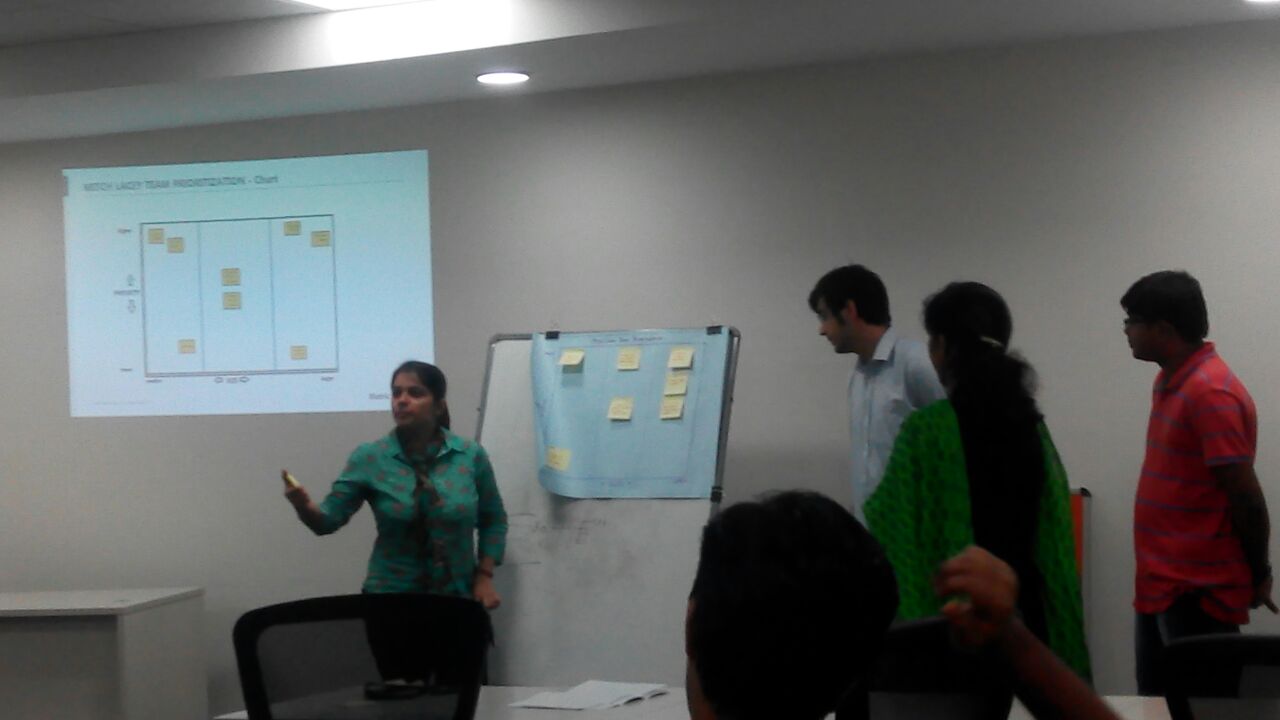
Agile needs continuous improvement and innovation , and we are striving for the same at my new workplace MetricStream, Bangalore. As a part of that, I was invited to conduct a session on some practical and easily adoptable agile practices.
Well what better than Innovation Games for that !
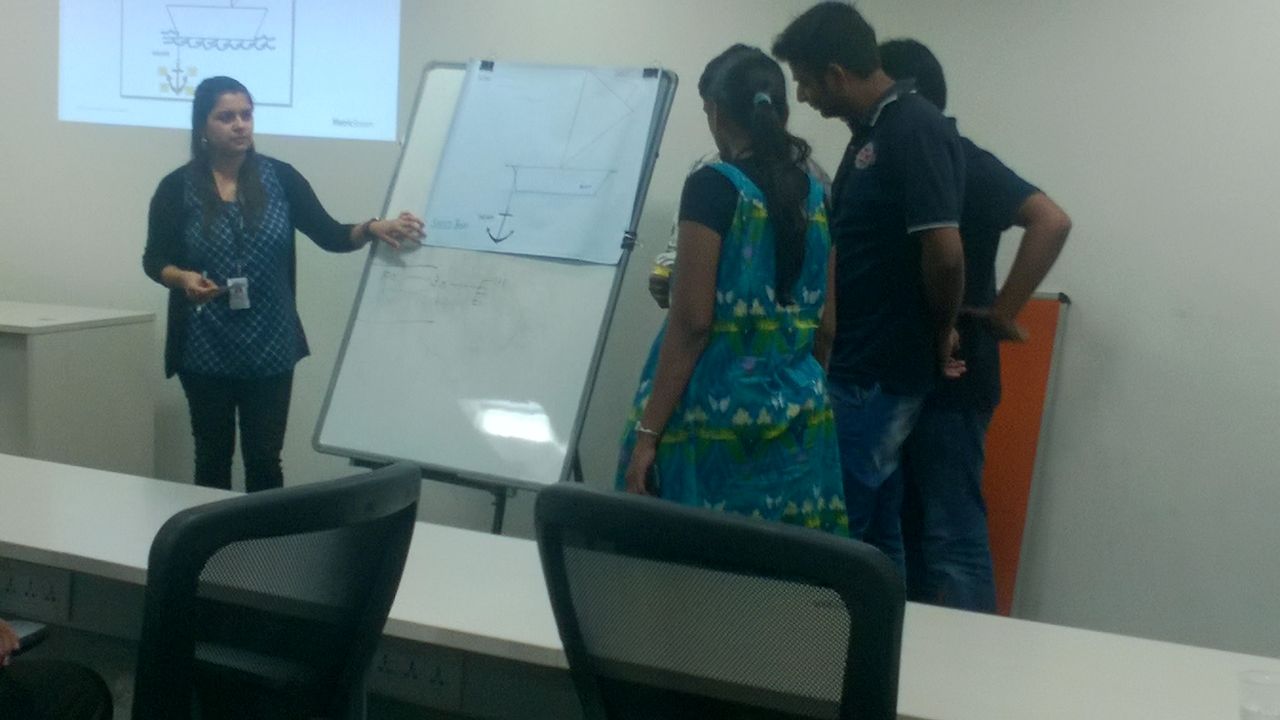
So we went ahead and did a 3-part practical training exercise session wherein not only did we learn about the Agile workflow , the basics on innovation games and how they fit into Agile , but also conducted practical group exercises with sample scenarios and user stories.
It was a great experience and received quite well. The participants were encouraged to take back the learning to their own scrum teams and try out the fun and quick games for conducting various Agile ceremonies.
Here is a glimpse into the training room :
Playing Innovation GamesPlaying Innovation GamesPlaying Innovation GamesPlaying Innovation Games
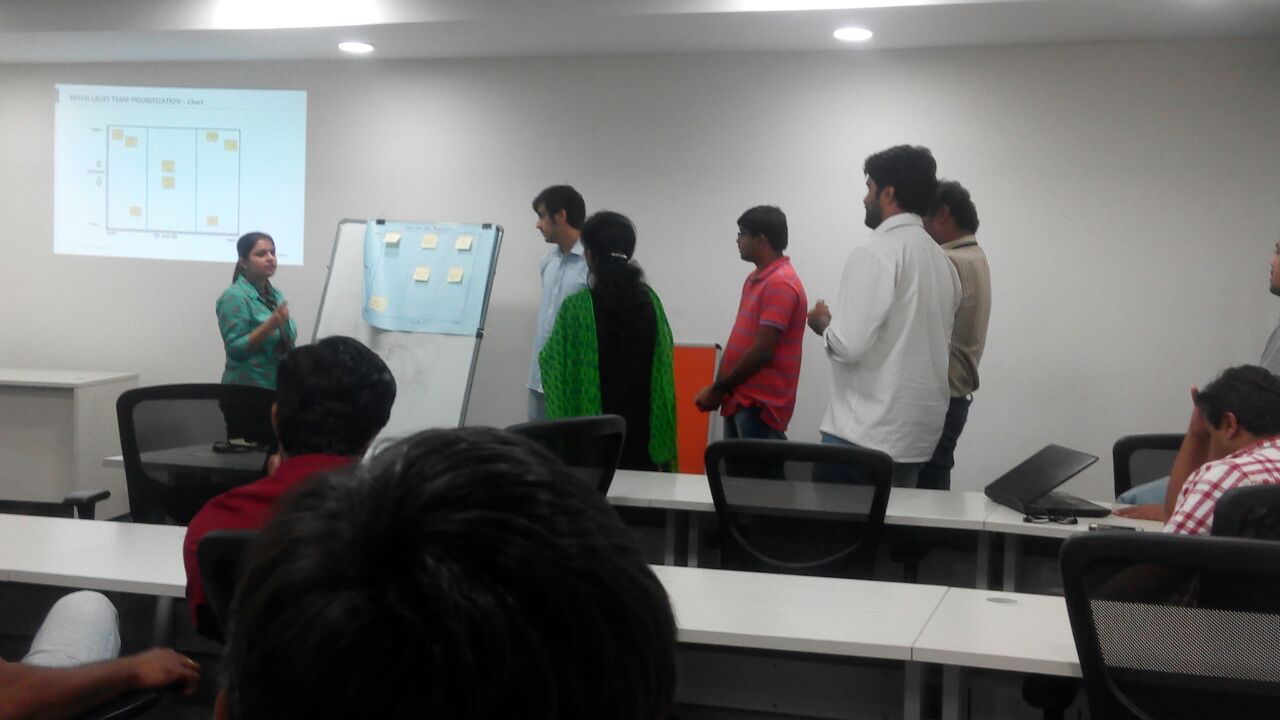
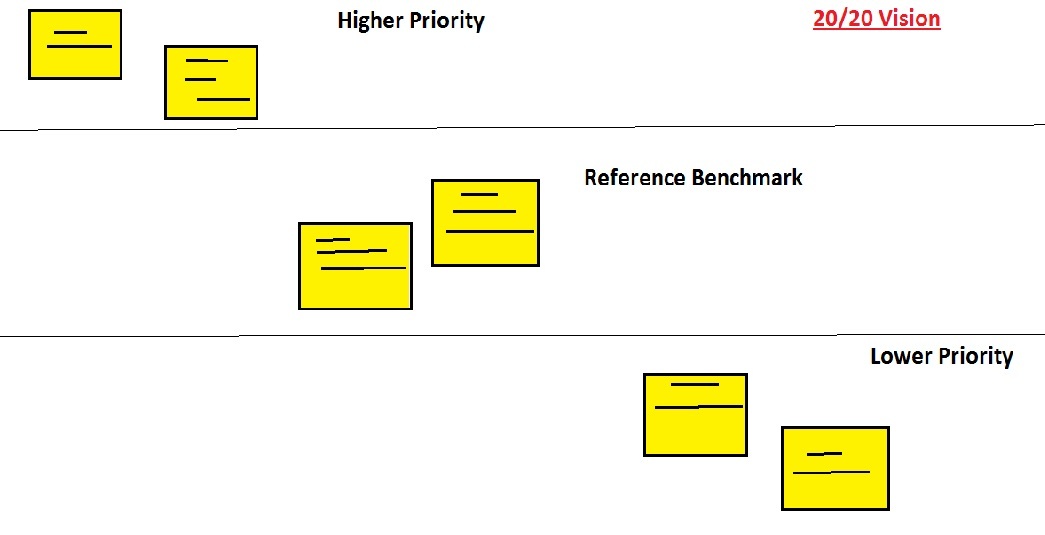
Here we have for you another Innovation Game centered around prioritization. It is a visual and crisp way to chart out and understand priorities of upcoming tasks , features or stories.
Game : 20/20 Vision
Aim : To chart out the RELATIVE priorities of the tasks at hand
Method: The 20/20 game elaborates the prioritization of each task in relation to a benchmark task of medium priority and complexity.
Just like a visit to the Optometrist, where he makes you compare the various lenses to find the best suitable for your sight, in this game we make the team compare all stories / requirements / tasks and find the right place for them on the chart of priority in relation to the one benchmark level.
Description: Write down all stories on post-its. With the team’s consensus and decision, decide on one story which is of medium level and put in on the board in the middle.
Now the team goes through each story one by one, and places the story on the board as higher or lower priority in relation to the benchmark story. At the end of the exercise, we arrive at a visual representation of the story or task prioritization, giving us a clear road-map for future!
This game takes almost 15-30 minutes only depending on the number of tasks at hand, as compared to long planning meetings.








 testwithnishi