Panel Discussion about Agentic Testing with LeadDev

Still buzzing from yesterday’s Panel discussion at LeadDev on “Are You Ready for Agentic Testing?”

https://leaddev.com/event/are-you-ready-for-agentic-testing

We unpacked some powerful themes there:

↩️ What agentic testing really is and How is it shifting testing from scripted execution to adaptive, autonomous quality.

🚧 How do you give agents sufficient context, guardrails, guidance to make them effective

🚐 Practical ways to integrate testing agents directly into our workflows.

🌵 A risks vs benefits analysis of using more autonomous agents & what it means for testers today!

I loved the depth of conversation, the questions, and the energy in the room! We got some amazing questions online from the participants, and the conversation continued on the slack channel later too.

A huge thank you to LeadDev for hosting and to my fellow panelists Richard Bradshaw Vernon Richards and Dan Belcher and our host Amanda Sopkin for putting together such a meaningful, future-focused discussion.

Always a privilege to share space with people pushing the boundaries of quality engineering!

#AgenticTesting #SoftwareTesting #QualityEngineering #Agile #DevOps #AIinTesting #ContinuousDelivery #TestAutomation #LeadDev #AI #AIDiscussions

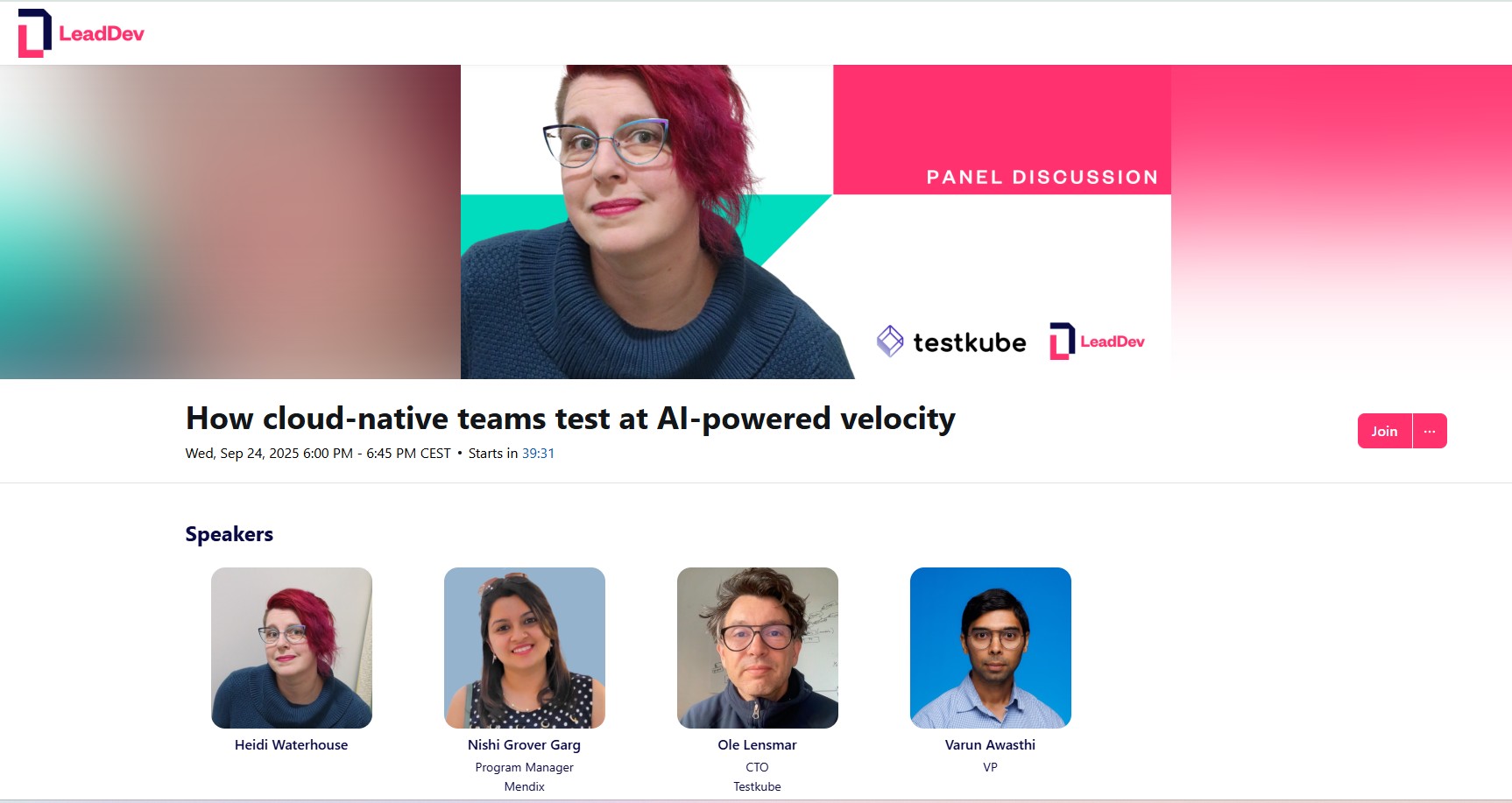
Speaking at LeadDev Panel Discussion: How Cloud-Native Teams Test at AI-Powered Velocity 🚀

What an honor it was to join the panel discussion hosted by LeadDev this week—alongside brilliant minds like Ole Lensmar, @Varun Awasthi, and our amazing & talented moderator Heidi Waterhouse.


Event Link: https://leaddev.com/event/how-teams-test-at-ai-powered-velocity


We tackled one of the most pressing questions in software today: How do we maintain quality and developer experience when velocity is being pushed to its limits—especially with AI tools accelerating the pace?
Here are a few of my favorite takeaways that resonated deeply:

🔍 Key Insights & Highlights


🌿 Orchestrating Tests in Cloud-Native Environments
Scaling test automation across Kubernetes and complex cloud infrastructures is no longer optional—it’s essential. We discussed patterns and practices that help achieve consistency and coverage without slowing things down.

🌿 Breaking Down Silos between QA, Platform, and Dev Teams:
Collaboration is critical. One recurring theme: embedding quality into every step, not isolating QA as a final gate. Cultivating shared responsibility ensures faster feedback loops and higher trust. LeadDev

🌿 Better Observability, Fewer Flakes:
Too often we drown in test noise. By improving observability—clearly distinguishing signal from noise—we can reduce flaky tests and focus on real quality signals. LeadDev

🌿 Developer Experience as a First-Class Concern:
Velocity is important, but not at the cost of a broken feedback loop. Optimizing for DX means tests must be fast, reliable, and integrated—so developers feel empowered, not burdened.

The depth of conversations, the invigorating questions, the connections made—all of it reaffirmed how powerful shared learning is.

A heartfelt thank you to the LeadDev team for inviting me and running such a seamless, high-impact event. And to my fellow panelists and everyone who joined the discussion: thank you for your insights, your challenges, and your curiosity. We grow by asking hard questions together!💡

Cheers,

Nishi

I am speaking at DevOpsCon Berlin (June 2025)

I am excited to share that I will be speaking at DevOpsCon Berlin next week, an event by devmio.

This event is known for its power workshops, practical learning avenues and networking with international community of Agile & DevOps enthusiasts, I am excited to be presenting not one but 2 sessions – one focused on No-Code Test Automation Revolution and another about Leading Scrum teams in dynamic environments.

The conference offers 4 full days of learning in the form of sessions, keynotes and workshops, with options to attend in-person or online – here is the full program https://devopscon.io/berlin/program-berlin/

As I prepare to travel to Berlin again, this will definitely be a new experience as a European native and having my family along with me! I am excited to meet some new people and reconnect with the amazing people I met in the past years.

Here are the details of my 2 sessions:

No Code Revolution: Redefining Test Automation for Speed and Simplicity

With numerous test automation tools and frameworks available today, many in the software testing industry are focused on learning them all. It is important to stay updated with new technology. But are testers losing something in the race to become more technical and equipped with automation skills? Is your test automation becoming so technical and code-intensive that it’s in danger of alienating the subject-matter expert testers who best know the core of your business?
Testing is a creative field and Test automation tools are the necessary technology that is meant to serve us.
Test automation is undergoing a paradigm shift with the rise of no-code platforms. This session dives into how no-code test automation tools are transforming traditional testing practices, enabling faster implementation, and making testing accessible to non-technical stakeholders.

Takeaways :
Attendees will discover:
>>What steps to take to not alienate your business testers and other key stakeholders from yoyr test automation.
>>How no-code platforms democratize test automation for Agile teams.
>>Techniques to reduce setup time and increase test coverage.
>>Practical insights into leveraging no-code tools for scalable, efficient testing

Mastering Scrum and Navigating Agility in Dynamic environments

Agile teams in startups can be in a constant state of flux, and creating harmony there requires mastering adaptive leadership techniques, relooking at processes and leaning them out to suit the needs of the teams. In this session, we will dissect the intricate dance of leading software delivery in startup agile teams, and discover actionable strategies for navigating the complexities of program management in fast-paced environments. 

Scrum masters, agile leaders and team members will gain valuable insights into aligning team efforts with business goals while maintaining agility and high-quality standards.

By the end of this session, you will:​

>Gain insights into adaptive leadership techniques tailored for startup agility.

>Learn practical approaches to balance speed and quality in software delivery.

>Explore effective methodologies managing scrum teams in dynamic startup ecosystems.

Empowering Enterprise Growth with Low-Code Platforms

<This is a guest post by Smith Mac>

In the rapidly evolving modern world, business changes in enterprises are violent and frequent, and therefore, the provision of innovative technological, many enterprise organizations adopt low-code development platforms into enabling the enhanced software development processes’ efficiency. In this conclusive and comprehensive tutorial low code aspect is discussed how it impacts organization and it also answers the critical questions with respect to traditional development to help the business to capture tremendous value in developing Ready Enterprise Applications.

1. Empowering Enterprise Outcomes through Low-Code Development

Low-code development platforms are becoming the key drivers of enterprise digital transformation by easing app development approaches. It reduces the practices of manual coding by a considerable amount, reduces time and cost of development while projecting a market growth of more than thirty percent CAGR by-year 2028. In this regard, low-code, by translating development into graphical interfaces, is the enabler for both IT and business personnel and a way to bring additional efficiency to the organization by improving development team’s velocities thus allowing to quickly adapt to market needs. It is friendly with existing IT environments and enhances legacy frameworks and third-party API for maximum return on investment while renewing applications.

Integrating Competitive Advantage into Operations

Implementation of low-code platforms means relatively increased productivity as organisations experience up to 50% reduction in the time to build application and maintaining them. This efficiency helps IT teams to avoid wasting their time on various usual tasks and shift more focus to unique tasks. However, integrated management and security mechanisms reduce the risks involved with Shadow IT, whilst adhering to stringent regulatory requirements. As more enterprises adopt low-code, they are able to deliver more applications faster to market and be more responsive to changing business requirements.

2. How Low-Code Development helps in Unlocking Enterprise Growth

Many organizations have turned to low-code platforms to ensure efficiency during the development phase and align with the DevOps concept. Forrester has it that low-code can help to speed up application delivery by as much as six times while at the same time halving development costs. This efficiency not only improves the speed for operations but also fosters the fairly essential accelerated rate of innovation for competitive advantage.

Low-code also makes application development more accessible to allow business users who are not IT experts to build applications that they require. It encourages cooperation between departments, ensures that IT works towards business objectives, and speeds up the working cycles to provide better customers’ experiences. Furthermore, the top low-code platforms are security and compliance-oriented as innovative security mechanisms are integrated into the platform to ensure proper protection of data and compliance with relevant regulations, thus reducing risks and increasing confidence.

3. Working Through the Problems of Traditional Software Development for the Enterprise

In the current environment of enterprises, the conventional software development faces issues that slow it down and prevent creativity. Complexity of development cycles and increasing costs are also significant projects issues with 68% of projects reporting delays and 45% reporting that their costs were higher than planned because of poor planning and communication. In addition, such methodologies as waterfall restrict the cross-functional team approach, which creates problems with immediate adaptation to market shifts and slows down time to market of key applications.

The primary social challenges for these enterprises are these hurdles, and therefore working with Agile and DevOps practices. There are mainly the following advantages of using agile methodologies: It encourages cross functional and cross organizational collaboration and thus teamwork, because the conditions are fully supportive of fast responses to changes in requirements and markets. Implementing DevOps does not only facilitate development but also increases deployment rates by 30x and reduces failure rates by 60x. Implementing cloud computing solutions, organizations also advance the use of cloud-native ones and microservices to improve scalability and being competitive in the digital market.

4. Realizing Increased Speed & Innovation with Low-Code Capabilities

Low-code is considered to be influencing the application development profoundly as it cuts across the time required in developing and implementing applications I superior ways. As per estimates, the CAGR is over 20% and these platforms dematerialize processes and include citizens, developers and IT persons. Since competition is high in today’s mart, reducing the time-to-market for new products and features are very critical for organizations.

Making the process of building applications accessible to more users is another advantage that comes with the use of low-code solutions. Benefits of collaboration are the ability of allowing users with different technical applications to change programs, processes and develop improvements, hence enjoying the flexibility of responding to the market and consumers’ feedbacks. Companies using low-code claim that their applications are delivered up to 50% faster, and this increases overall business functionality and customer satisfaction.

Additionally, low code enables CI/CD requirements as essential for today’s DevOps frameworks. These are easily integrated with the existing tools and processes and reduce the time spent and errors in the deployment of the software. This helps to liberate the development teams to concentrate on new value creation, thus increasing the organizational flexibility.

5. The Possibilities of Low-Code Solutions for the High-End Business Applications

Leveraging the full potential of low-code as the foundation for delivering enterprise-level solutions is transforming applications development. For enterprises, it represents that adequate use of low-code can avoid much hand-coding in the development of complicated applications, thus shortening the TTM and improving the flexibility. According to the market report, it will exhibit a CAGR of over 25% by 2028; low-code development platforms enable organisations to deliver new solutions at a greater pace.

Read More »