Working from Home? Five Tips to Keep Your Sanity and Productivity Intact

As teams and companies across the globe are following social distancing recommendations, many workers are wading into unchartered territory. How are you supposed to maintain any kind of workflow when your surroundings (and mental state) are different from what you’re used to?

If you are new to working from home, here are five tips to help keep your sanity and productivity intact! Read Full article at https://blog.gurock.com/working-from-home-tips-productivity-sanity/

Embrace the Change

Working from home will be different from working from your office. You might miss the human interaction — the lunches with your team or the coffee breaks and informal chats. You might also feel derailed from your goals a little as you figure out the dynamics of online collaboration tools, remote meetings, and screen-sharing applications that take away time from your actual work.

But this is not the time to get bogged down by these changes. Since most of it is out of your control anyway, it is better to embrace the changes — or at least accept them — to give yourself peace of mind. Try not to fight your new situation or get negative about it.

Manage Your Distractions

Your day at home will be filled with many distractions that may take your focus away from your work. Working can be hard when you see that sink full of dishes or a dirty living room that needs a vacuum. I personally find myself rushing to the kitchen every hour to fix myself a snack, just because I am so close to it! You may also have partners, children or other people living with you who are trying to get through their day too.

It is imperative to create a routine that helps you manage these distractions. First, try to set your work hours at a time that fits your day and your family. Your at-home work hours may not be the same as your in-office work hours, and that is OK. If you can wake up early to get a couple of hours of work done before your kids are up, do that! It will start your day off on a productive note and you will feel less stressed about spending an hour feeding your toddler breakfast. Once you get them to settle down for the day with schoolwork or an activity, you can resume working.

If you have a partner also working from home, manage your time with them in mind. What are the best times to begin working? Do you both want to take a break to have lunch together? How can you split your chores so that you are not perpetually stressed and distracted with them?

Even if you live alone, having a routine and set times for beginning work, having a snack or lunch, and finishing work will help you keep your focus and get things done!

Designate Your Space

This is the most important factor when living with someone else. Being productive requires a space of your own and the feeling of being at work. Even if it is as little as setting up a desk, using a corner in the living room or making your couch your work area, you will need to make the effort! Have your laptop, books, chargers and other stuff you need at hand, and set up that area to feel like your workplace from now on. Use that space consistently for at least a few hours each day and keep distractions to a minimum. 

If you are lucky enough to have a study, home office or other separate room to work, you might need to coordinate with your partner on using the desk at different parts of your day. My husband and I use our study room alternately, mostly with me spending the first part of the day there while he uses it in the later half of the day, since most of his work calls happen at that time. If you and a partner or roommate are both scheduled for calls at the same time, decide on your separate areas and give each other space to work in peace…….

Read More — > https://blog.gurock.com/working-from-home-tips-productivity-sanity/

Published at (https://blog.gurock.com/)

Blind Spots in Software Testing

Reduced awareness or unintended ignorance of certain aspects can lead to inattentional blindness, or the failure to notice something that should have been visible because our attention was engaged elsewhere. As a human psychological concept, inattentional blindness also plagues testers and their mindset when testing. In my latest article for Testrail blog, I look at some steps we can take to overcome this challenge and avoid blind spots in our testing work.

Target Fixation

It is a natural response of our brain to avoid getting overloaded with information. It automatically focuses on information that is most important while avoiding unnecessary details and noise.

In many situations, this manifests in our focus on the task at hand and its context so much that we neglect surrounding details. This is true for day-to-day activities like bumping into a pillar while looking at our phones, failing to see a swerving car when watching the road ahead… or not noticing a takeaway coffee cup in the middle of a popular television show set in ancient times!

Let’s say you are browsing through a website with the intention of looking at the layouts that must match provided mockups. While you are doing that, you may miss the following:

  • The homepage of the website has an older logo of the company that should have been replaced by the newer version.
  • The login box has username and password fields but the login button is missing.
  • The URL structure of the website is all wonky and the individual page URLs are not named correctly.

Overlooked Information

Testers often execute tests that have defined steps and expected results, so we frequently overlook anything that is not defined and only check for the results we’re looking for. The tester’s mind is attuned to looking for specified errors, while other information or defects may tend to get missed, even though they may be right in front of our eyes.
Pick up any passed test case and try to re-execute it, but this time keep an open eye and an open mind for any new information surrounding the test. More often than not, you will find that many more defects, risk areas or questions can be found in the same area, despite the test having passed.

Read More—>

Read complete article at https://blog.gurock.com/blind-spots-software-testing/

How Technology Has Changed Project Management

The use of advanced technology in business environments can sometimes be jarring. Adjustments can be difficult, and on top of that many employees across a range of industries worry that technology can make them obsolete. These can be legitimate concerns in some cases. But, more often than not, technology serves instead to simplify processes and, ultimately, make life easier on people as they go about performing their jobs. This is certainly proving to be the case where project management is concerned.

Project management demands and processes vary across different businesses and industries, which means that not all teams in this category can implement modern technology in exactly the same ways. Here we’ll examine a few key ways in which tech can and has changed project management for the better.

Communication & File Sharing

Maybe the biggest change that technology has brought about for project management teams is a simplification of communication among groups in a work setting. In 2019, our post on ‘Overcoming Barriers to Effective Communications in Agile Teams’ touched on the idea that various barriers to regular communication can negatively impact productivity. And the same is absolutely true for project management teams of all kinds.

Now, however, there are several different communications platforms that are being used in professional environments to streamline collaboration. Often enough, they’re used to simplify digital communications in office environments in general, providing a space where everyone from a manager to a part-time freelancer can log in, see shared information, engage in relevant chats, and generally stay up to speed. These platforms can also be invaluable for project management teams.

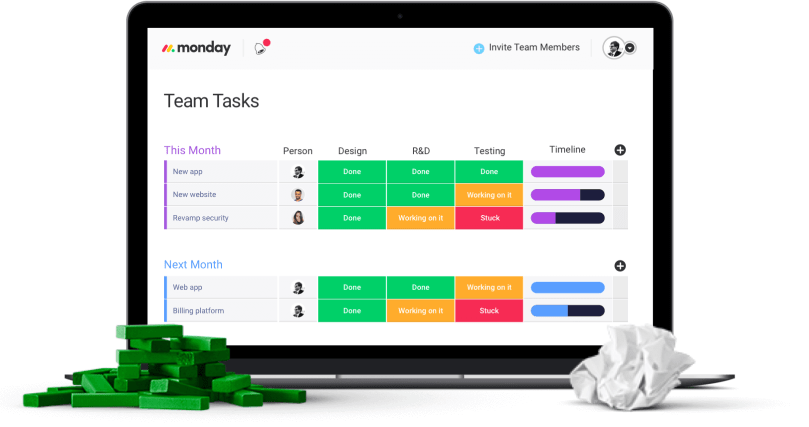
For instance, think about a fairly common project such as developing a website or an app for a business. These are projects that involve contributions from people with different skills in conjunction with one another. A page design can’t be completed without understanding of the content layout; content layout can’t be finalized without a thoroughly developed visual aesthetic, and so on. On these modern communication platforms, these matters can easily be discussed between relevant parties such that the greater project can move forward. Updates and examples can be shared, and people can easily work with relevant collaborators whenever they need to.

Collaborative Design

In the past, one issue that plagued some project management teams is how to get everyone on the same page in more multi-faceted projects. There haven’t always been structured ways for different aspects of one overarching project to be addressed in a cohesive manner. This is changing, however, thanks in large part to both abstract and specific software.

Read More »

How to become a self-taught Tester in 2020

Learning is an ongoing process, and hopefully a lifelong one. Being a professional in any field requires you to constantly update your knowledge and continue to learn.

Software testing is a very in-demand role, so many people aspire to get into this line of work — but they may not know where to begin.

If you are fresh out of college or looking to switch careers, even if you are not from a computing or engineering background at all, you can jump-start your career in testing. In my article published at TestRail blog, I have given some tips and advice on how to become a self-taught software tester this year.

Read

Books provide a world of knowledge, and despite shifting trends, books can never be outdated, as older ideas can give you a foundation for new information. Reading a book allows you to delve deeper into a topic of your choice at your own pace.

  • Begin by searching for books on software testing, quality assurance practices, and industry leaders.
  • Then seek books that can help you start applying the knowledge.
  • If picking up a physical book is not your cup of tea, read online — there are many great portals with awesome content, articles, and ideas.

Diversify Your Knowledge

Software testing is not a singular skill; it requires a number of skills, both technical and non-technical. When beginning your quest to learn about software testing, delve into various areas of the domain and look for what interests you the most.

Read More »

The Art of Bug Advocacy

Testers find defects and raise awareness about quality. What happens after the bugs are found can be any tester’s guess, though. Bugs may get delayed, postponed, go unnoticed or linger on due to lack of information.

In my article for Ranorex blog, I talk about how Testers need to champion the cause of their bugs in order to avoid unneeded delays in fixing defects that are important. At the same time, testers should maintain a distance to make it an impersonal and impartial experience. Testers need to master the art of bug advocacy!

Why is advocacy important?

Advocacy is basically pleading the case for a bug to be fixed. The testers who find the bugs are the ones who need to advocate for their bugs. It is important that they take a stand and voice their opinions.

Some bugs may not be deemed important from a business perspective, as they seem too small. But in reality, they may be blocking an important feature for a particular user group. On the other hand, some bugs may seem more critical than they truly are, and while fixing them may be important, it may not be the highest of priority.

Whatever the case, testers must aim to present the facts and data in such a way that decision-makers are able to make well-informed resolutions about the issue.

Communication is key

Advocating for anything is not a one-way street. It takes discussion, debate and reaching a consensus on key points to make a collective decision. This is where testers’ communication skill plays a key role. Testers need to have good communication, both verbal and written.

Read More »

Understanding Burnout Symptoms in Tech Workers

Work in the tech industry is very demanding. We pointed out before in our article entitled ‘Mental Health for People in Tech’ that this industry is characterized not only by long work hours, but also high stress and great pressure to perform well — all of which can adversely impact your mental health. Not only that, but they can also cause burnout, which is defined by the World Health Organization (WHO) as a syndrome caused by chronic and unmanaged workplace stress. Sadly, we often fail to recognize when we are suffering from it.

That said, this article will help you identify burnout symptoms so you can understand this syndrome better for yourself and for those around you who might be experiencing it too.

The Symptoms

The following are some warning signs of burnout:

Irritability and indifference

Tech Republic notes in an article on burnout warning signs that being irritable and indifferent are telltale signs of burnout. Granted, getting irritated is a normal reaction — but if it happens more than usual or if you end up snapping at someone for the smallest reason, you’re likely burned out. The same holds true when both your attention to detail and job interest wane. This increasing detachment is one of the three dimensions of burnout, according to the WHO.

Exhaustion

It’s normal to feel tired at the end of your work shift, but if you feel drained just hours (or even minutes) after starting work, then you’re probably burned out. This energy depletion is yet another dimension of burnout, and it can be exacerbated by the long hours expected of you.

Read More »

Personality Traits that make a great tester

Testing concepts and techniques can be learned. But having a knack for testing is different. What makes someone a born tester? What are some personality traits and skills that can make a person innately good at this profession?

In my latest article published at https://blog.gurock.com/natural-traits-great-tester/ , I have described four traits that belong to people who naturally make great testers. Developing these traits can help you in your testing career, and if you are a manager, these are the traits to seek when looking to hire new testers for your team!

  • Communication
  • Empathy
  • Curiosity
  • Meticulous Organisation

These traits may not have much to do with technical side of the job, but they surely contribute to the testing mindset and success of a great tester in a team. Read the full article -> https://blog.gurock.com/natural-traits-great-tester/

The Partnership of Testing and Checking

Human Testing is a craft that is more than executing a bunch of tests, performing clicks and actions. A tester has a unique understanding of the system and ways to critique it. Over time, the tester develops a deeper comprehension of the application and its intricacies, integrations, weak points, and history. This makes them the best judge to find out the failure points of the system and comment on its health.

The Product Risk Knowledge Gap is the difference between what we know about the product and what we need to know. The purpose of testing is to close or at least reduce this gap.

While automated checks can help in determining problems in what we know (and have scripted as checks), it may not help as much in the risk areas of what we do not know about the product. That requires exploration, creativity, intuition and domain knowledge. This is the human aspect of testing.

The creative and human aspects of testing lie with the tester, which I have experienced as well as written about a few years back as a hands-on tester myself here – https://testwithnishi.com/2014/12/31/automation-test-suites-are-not-god/

Your Name: Review:

Automated Checks-

Automated scripts have some built-in steps in the form of test data that we pre-define and verifications that we add. These steps are helpful for areas of the application that we need to check, double-check or re-check a number of times, and because these types of checks can be made explicit, they can be automated. Since the same steps will be performed the same way over and over again, it is better called “checking” rather than “testing.”

Read More »

Top 3 New Year Resolutions for Testers!

Here we are gearing up for another new year! As time flies by, we may start to feel stuck in one place, unable to move forward in our careers. Testers can get bogged down by too much to learn, too many directions to take, and so many tools and technologies.

But that’s no reason to stagnate. By making some goals now, you can aim to start improving yourself and your career development right away on January 1st.

Here are three goals testers should have for the coming year. Make it your New Year’s resolution to achieve them, and go for it with an action plan in hand! Read the full article at –> https://blog.gurock.com/new-year-resolutions-testers/

Improve your Mindset

The first resolution should be to create and maintain a healthy mindset. Mental peace and team harmony should be the goal.

Continue Learning

There must be a routine, a drive to better oneself and a constant search for improvement. All testers must resolve to take up some kind of continuing education so they can always be adding to their skill sets. Learning cannot be a one-time activity.

Get Better at Networking

The next resolution a tester must make is to participate in the community in some way.
The knowledge you have is better shared with others, and the pace of learning in a community will be much faster than alone.

Read More —>

Mental Health for people in tech

The technical industry is characterized by high stress, long work hours as well as workplace pressure. This demanding environment blurs the line between your professional and personal life.

Your mental health suffers a lot in the constant social pressure to network and make a name for yourself. Here, are certain ideas to implement at your workplace to take care of your mental health.

Speak your mind

Speaking your mind can help you maintain your mental health. Don’t consider sharing your feelings as a sign of weakness; it’s a part of taking charge of your wellbeing.

Though it’s hard to talk about feelings at work, but if you have colleagues you can talk to, it can really help. Find your tribe at work who can be your peers with whom you can share your day to day problems, issues and seek advice, or open up with family and friends outside work.

Identify triggers

Everyone has different triggers for anxiety in the workplace. It could be doing a presentation or writing reports or going to a company function. You must track situations that make you uncomfortable in order to prepare.

Read More »